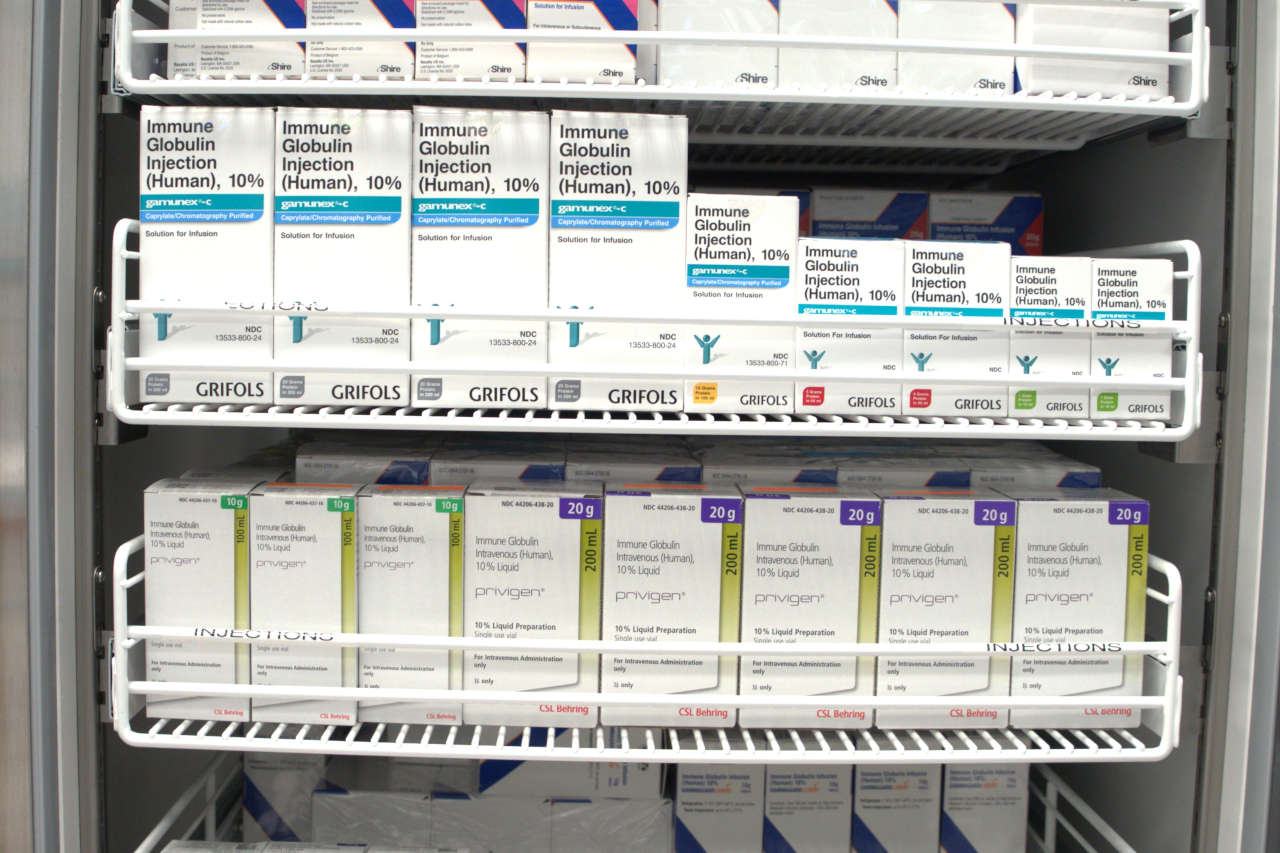
Although all IVIG brands contain immune globulin G (IgG) as the active ingredient, each product differs slightly in formulation, concentration, stabilizers, IgA content, and FDA-approved uses. These differences can affect infusion time, tolerability, side effect risk, and product selection for specific patients. They can differ in IgG concentration, IgA content, available forms (liquid vs. powder), and inactive ingredients, particularly sugar (sucrose) and sodium.
Important: Patients should never switch IVIG brands without consulting their healthcare provider. Even small formulation differences between products may affect tolerability and infusion-related reactions.
A Quick Overview of IVIG Brands in the US
The following IVIG products are currently FDA-approved in the United States:
- Alyglo (Manufacturer: GC Biopharma)
- Asceniv (Manufacturer: ADMA Biologics)
- Bivigam (Manufacturer: ADMA Biologics)
- Flebogamma DIF (Manufacturer: Grifols)
- Gammagard Liquid (Manufacturer: Takeda)
- Gammagard Liquid ERC (Manufacturer: Takeda)
- Gammagard S/D (Manufacturer: Takeda; planned discontinuation announced for December 2027)
- Gammaked (Manufacturer: Kedrion)
- Gammaplex (Manufacturer: Kedrion)
- Gamunex – C (Manufacturer: Grifols)
- Octagam (Manufacturer: Octapharma)
- Panzyga (Manufacturer: Octapharma)
- Privigen (Manufacturer: CSL Behring)
- Qivigy (Manufacturer: Kedrion)
- Yimmugo (Manufacturer: Biotest AG)
IVIG Brands and Their FDA-Approved Uses
IVIG products are FDA-approved for several immune and neurologic conditions, including:
- Primary immunodeficiency (PID)
- Immune thrombocytopenic purpura
- Chronic inflammatory demyelinating polyneuropathy (CIDP)
- Multifocal motor neuropathy
- Chronic lymphocytic leukemia
- Kawasaki disease
- Dermatomyositis
- No single IVIG brand is approved for all indications.
- Nearly all IVIG brands are approved to treat primary immunodeficiency, with minor variations in specific brand strengths.
- Only Gammagard S/D 5% can be used for chronic lymphocytic leukemia and Kawasaki disease.
- Only Octagam 10% can be used to treat dermatomyositis.
- Alyglo (approved in 2023), Asceniv (approved in 2019), and Yimmugo (approved in 2024) are relatively new IVIG brands.
| IVIG Brand | Uses |
| Alyglo | Treatment of primary humoral immunodeficiency (PI) in adults 17 years and older |
| Asceniv, Bivigam, and Gammagard Liquid ERC | Treatment of primary humoral immunodeficiency (PI) in adults and children 2 years and older |
| Flebogamma | Flebogamma 5% DIF: Treatment of primary immunodeficiency in adults and children 2 years and olderFlebogamma 10% DIF: Treatment of primary immunodeficiency and chronic primary immune thrombocytopenia (ITP) in patients 2 years and older |
| Gammagard Liquid | Treatment of multifocal motor neuropathy (MMN) in adults |
| Gammagard S/D | Treatment of primary immunodeficiency in adults and children 2 years and olderPrevention of bacterial infections in hypogammaglobulinemia and/or recurrent bacterial infections associated with B-cell chronic lymphocytic leukemia (CLL)Prevention and/or control of bleeding in adults with chronic idiopathic thrombocytopenic purpura (ITP). Prevention of coronary artery aneurysms associated with Kawasaki syndrome in children |
| Gammaked | Treatment of idiopathic thrombocytopenic purpura (ITP) in adults and children, primary humoral immunodeficiency (PI) in individuals two years and older, and chronic inflammatory demyelinating polyneuropathy (CIDP) in adults |
| Gammaplex | Treatment of primary humoral immunodeficiency diseases (PIDDs) in adults and children 2 years and older, and prevention of bleeding in idiopathic thrombocytopenic purpura (ITP) |
| Gamunex – C | Treatment of primary immunodeficiency and CIDPIncreases platelets in patients with idiopathic thrombocytopenic purpura (ITP) |
| Octagam | Treatment of primary immunodeficiency, chronic immune thrombocytopenic purpura (ITP), and dermatomyositis |
| Panzyga | Treatment of primary humoral immunodeficiency (PI), chronic immune thrombocytopenia, and CIDP |
| Privigen | Treatment of primary immunodeficiency in adults and children 3 years and older,chronic immune thrombocytopenia in adults and children 15 years and older, and CIDP in adults |
| Qivigy | Treatment of primary humoral immunodeficiency (PI) in adults |
| Yimmugo | Treatment of primary humoral immunodeficiency (PI) in individuals 2 years and older |
Different IVIG Brands and Their Composition
IgG is the main ingredient of all IVIG brands, but Ig concentration, IgA content, and inactive ingredients can vary among different brands.
Ig concentration and purity
- Alyglo, Asceniv, Bivigam, Gammagard Liquid ERC, Gammagard Liquid, Gammaked, Gamunex – C, Panzyga, Privigen, Qivigy, and Yimmugo contain 10% IgG.
- Gammagard S/D contains 5% IgG.
- Flebogamma, Gammaplex, and Octagam are available in two strengths: 5% and 10%.
Why might this matter?
IgG concentration can influence infusion duration because higher-concentration products (10%) deliver the same dose in a smaller fluid volume compared with 5% formulations. For example, patients receiving 10% IgG typically have a shorter duration of infusion than those receiving 5% IgG [1].
Some patients may experience more infusion-related side effects, such as headache or fatigue, with higher-concentration products, particularly when infused rapidly. Yet, both concentrations are safe and well-tolerated.
IgG purity in different brands ranges from 90% to 98% [2]. For example, IgG purity in Gammagard S/D is 90%, while it is 98% in Gammagard Liquid, Gamunex – C, Privigen, and Gammaplex.
Although higher IgG purity is generally considered desirable, current evidence does not clearly demonstrate that products with higher purity consistently produce better clinical outcomes or fewer side effects.
IgA content
All brands contain small amounts of IgA. Patients with severe IgA deficiency and anti-IgA antibodies may have a higher risk of allergic or anaphylactic reactions to IVIG products containing higher IgA levels. However, a low-IgA brand does not completely rule out the risk of infusion-related side effects.
Brands with low IgA content are Flebogamma and Gammaplex, with Gammagard S/D having the lowest amount of IgA.
Sugar content
Sugar present in some brands may increase the risk of kidney injury in some patients. Certain sugar-stabilized IVIG products may require caution in patients with kidney disease or diabetes.
Note: According to the Immune Deficiency Foundation (IDF), sucrose-containing IVIG brands are no longer available on the US market.
Sodium content
Sodium content varies among IVIG products and may be an important consideration for patients with hypertension, heart failure, or kidney disease. IVIG brands with higher sodium content may not be suitable for patients with high blood pressure or poor kidney function.
Many IVIG brands, such as Flebogamma, Gamunex – C, Privigen, and Panzyga, contain trace amounts of sodium. On the other hand, Bivigam, Gammagard S/D, and Gammaplex 5% contain high concentrations of sodium.
Different IVIG Brands and Their Dosage Forms
Liquid dosage forms may offer greater convenience than powder because they do not require mixing before administration. Ready-to-use liquid formulations may reduce preparation time and simplify administration compared with lyophilized (powder) products.
IVIG brands available as liquid are Gammagard Liquid, Privigen, Gamunex-C, Octagam, Flebogamma, Gammaplex, Bivigam, Gammaked, Asceniv, Panzyga, Yimmugo, and Alyglo.
The only commercially available brand in powder form is Gammagard S/D.
Can One IVIG Brand Cause More Side Effects Than Another?
IVIG-related side effects depend on multiple factors, including infusion rate, hydration status, underlying medical conditions, and the specific product used. These include co-existing medical conditions, composition of a particular IVIG brand, and infusion rate. Typically, fast infusion rates are associated with more side effects.
Common side effects include headache, fever, chills, fatigue, nausea, flushing, and rash. They are often managed with slower infusion rates and IVIG premedication.
Is One Brand More Effective Than Another?
Current evidence does not show that one IVIG brand is universally superior to another across all patients and conditions. The success of IVIG treatment depends on several factors, including the condition being treated, treatment response, and individual patient factors.
However, a healthcare provider may prescribe a particular brand based on their experience. Moreover, the choice of a particular IVIG product may depend on product availability, accessibility, cost, and insurance coverage.
Can You Switch From One IVIG Brand To Another?
It is best not to switch from one IVIG brand to another. However, healthcare providers may recommend switching products because of side effects, insurance formulary changes, product shortages, infusion tolerability, or patient-specific clinical considerations. [3].
IVIG Brands, Cost, and Insurance Coverage
IVIG is an expensive therapy, with an initial cost ranging from $5,000 to $10,000 per treatment cycle. The primary determinants of cost are the number of infusions a patient needs and the patient’s body weight.
Most insurers cover FDA-approved IVIG brands if the treatment is “medically necessary” and other policy criteria are met. They also require prior authorization and have a list of “preferred” and “non-preferred” products.
Review your insurance plan to find out if your insurer covers your particular IVIG brand and route of administration. Also, check if they have any other restrictions on your IVIG treatment.
Medicare covers the cost of IVIG medications if they are prescribed for the treatment of primary immune deficiency at home. However, Medicare does not pay for other services, such as nursing services and supplies.
Final Thoughts
Choosing the right IVIG product involves more than selecting a brand name. Factors such as FDA-approved indications, IgA content, sodium levels, infusion volume, insurance coverage, and patient-specific medical conditions all play a role in treatment selection.
Patients should work closely with their healthcare provider and infusion team to determine which IVIG formulation is safest, most effective, and best tolerated for their individual needs.
References:
- Sajiki, D., Nishio, N., Kato, T. et al. Impact of 10% vs. 5% immunoglobulin products on treatment outcomes in Kawasaki disease: a multicenter retrospective study. Sci Rep 15, 18502 (2025). https://doi.org/10.1038/s41598-025-03395-9
- Takeda. (2021). Product characteristics and clinical considerations for Ig therapies. https://www.gammagard.com/content/dam/takeda/imported/gammagard/pdfs/hcp-product-characteristics.pdf
- Bethune, Claire, and Richard Herriot. “Switching immunoglobulin products, what are the implications? Result of 2018 census of immunology centres.” Clinical medicine (London, England) vol. 19,3 (2019): 201-204. doi:10.7861/clinmedicine.19-3-201